



Full of valuable goods! Researcher Wang Qingsong from the University of Science and Technology of China discusses lithium-ion battery fire extinguishing technology
Release Date:2020-12-07 Source: View count:791
On November 18-20, 2020, the 2020 International Summit on Energy Storage Safety was held at the Century Jinyuan Hotel in Hefei. At the meeting, Wang Qingsong, a researcher at the University of Science and Technology of China, delivered a keynote speech entitled "Electrochemical Energy Storage Power Station Safety Assurance Technology".


Under the dual impetus of national policies and social development needs, the electrochemical energy storage and new energy vehicle markets are rapidly developing, and the overall ownership of lithium-ion batteries is increasing year by year. Due to the active nature of lithium-ion batteries, they are prone to thermal runaway and fire when in various abusive states. Therefore, in recent years, whether in the field of energy storage or new energy vehicles, lithium-ion battery fire and explosion accidents have occurred frequently. Several forms of abuse, such as mechanical abuse, electrical abuse, and thermal abuse, are the main causes of lithium-ion battery fires. Simply put, mechanical abuse refers to the situation where the battery loses its integrity under external impact or is easily punctured by external forces, resulting in a fire; The abuse of electricity refers to the internal growth of dendrites under high temperature conditions, which generates a large amount of heat and causes battery fires; Thermal abuse refers to the heating of a battery caused by external environmental temperature or other factors, which can also lead to ignition and the production of a large amount of gas.
In terms of prevention and control methods, the first one is the safety of the battery itself. By modifying lithium-ion materials and adding flame-retardant media, the battery can achieve its own safety, so that even under abusive conditions, lithium-ion batteries will not experience thermal runaway or fire.
The second is process safety, which involves real-time monitoring of the status of lithium-ion batteries to predict their development trends and provide graded warnings.
Finally, regarding fire safety, by comparing the suppression effects of various fire extinguishing agents on lithium-ion battery fires, the best extinguishing agent was selected; And through reasonable working condition design, various fire extinguishing systems can play a better role in extinguishing battery fires. Conduct fire extinguishing tests on container fire extinguishing platforms of different sizes based on the size of the battery, including loss of control tests and fire extinguishing tests.
Experimental effects of different fire extinguishing materials
Firstly, for dry powder, corresponding experiments will be conducted for different spraying angles and spraying times. The experimental conditions set are different from those in the actual system. The experiment is aimed at a single battery without any wrapping or covering, so the fire extinguishing agent can fully act on the battery. Observing the changes in surface temperature when using dry powder fire extinguishing agents and when not in use, the results show that under appropriate conditions, dry powder can extinguish the flames of the battery and has a cooling effect, but cannot directly block the chemical reactions inside the battery during thermal runaway. In addition, at different injection distances, angles, and times, the decomposition reaction of dry powder is an endothermic reaction, which has a certain cooling effect on the combustion material. In addition, the decomposition of dry powder produces ammonia gas, which has a certain inhibitory effect on the free radicals of gas-phase combustion reaction and can interrupt the combustion chain reaction.
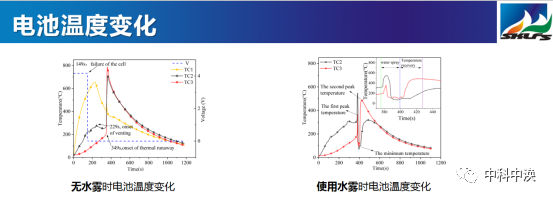
Next is water mist, and this experiment uses a 4AH NCM system 21700 lithium-ion battery. In the case of completely free combustion, using water mist to extinguish the fire quickly suppresses the flame, but the temperature tends to increase. On the left side, when water mist is not used, the temperature is very high, close to 800 degrees, but after using water mist, there is a rapid cooling process. After testing a single battery cell, a fire extinguishing test was conducted on the battery pack, and it was found that applying water mist can effectively prolong the spread time of thermal runaway, reduce the severity of thermal runaway, and generate sparks after stopping spraying, leading to reignition. At the same time, it can be seen that the battery has experienced thermal runaway again in the later stage, so in order to achieve good results, the water mist spraying time must be long enough. Subsequent experiments have shown that sufficient water can effectively suppress the spread of thermal runaway, but due to the low contact efficiency between water mist and batteries, the actual required water volume will be much higher than the theoretical calculation value.
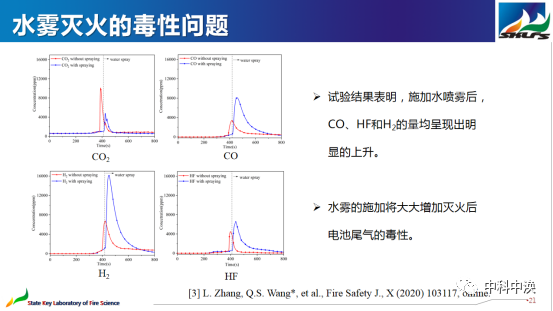
From this result graph, it can be seen that the gas changes after using water mist to extinguish the fire, with a decrease in carbon dioxide content but a significant increase in carbon monoxide, as well as an increase in hydrogen and hydrogen fluoride content. This increases the danger for firefighters and rescuers, so lithium battery fires must be extinguished in a timely manner.
The third one is heptafluoropropane. The heptafluoropropane test uses a 50AH lithium-ion battery. When released, the pressure of heptafluoropropane is relatively high, which has an impact on the flame and can effectively extinguish it. From the perspective of the fire extinguishing effect of three battery packs, flames can also be suppressed. Physical cooling also plays a role in chemical suppression, and to a certain extent, it also isolates oxygen.
Finally, perfluorohexane. When not using perfluorohexane, there is a noticeable jet fire process. After the application of perfluorohexane, there was no open flame in the battery, but a large amount of smoke was released and the battery did not reignite. The fire extinguishing mechanism of perfluorohexane is liquid at room temperature, and upon contact with high-temperature batteries, it can carry away a large amount of heat through phase change. In addition, it can cut off the free radicals of flame combustion, indicating more of a chemical inhibition effect. During the experiment, a clamp was used to clamp the battery from both sides, and the effective area of the fire extinguishing agent was very limited, resulting in a high temperature rise. In the later stage, the dosage was increased to optimize the cooling effect of perfluorohexane fire extinguishing. After fitting multiple surface temperatures together, the optimal dosage was found.
Single perfluorohexane is not ideal for cooling, so experiments were conducted in combination with fine water mist. The results showed that when perfluorohexane and fine water mist were used in combination, the peak temperature of the battery was lower and the cooling rate was faster.
Under the same experimental conditions, the effectiveness of several fire extinguishing agents was compared. During free combustion, spray carbon dioxide, heptafluoropropane, and fine water mist to observe the fire extinguishing effect. There is still a flame after using carbon dioxide, and there is also a small amount of combustion after using heptafluoropropane. There is no combustion when using fine water mist, so the cooling effect of fine water mist is relatively better than that of carbon dioxide and heptafluoropropane.
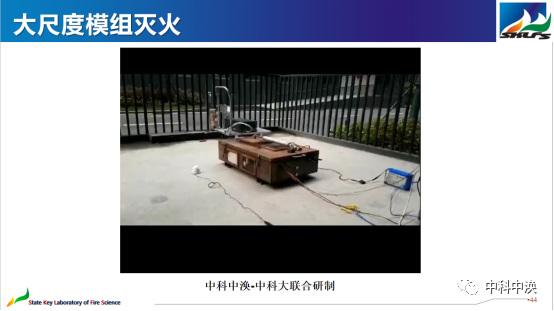
This is a large-scale battery pack fire extinguishing test jointly developed by the Fire Laboratory and Zhongke Zhonghuan. It uses a 300 ampere hour lithium iron battery to extinguish the fire after it ignites. While the fire slowly extinguishes, it is continuously cooled down to achieve a combination of fire extinguishing and cooling effects.
Through the above research, it can be seen that several fire extinguishing agents can basically extinguish flames, but the cooling effect is different, and some may experience reignition. When perfluorohexane and fine water mist fire extinguishing systems work together, the battery shows significant cooling after extinguishing. The above experimental conclusions are based on the results of specific batteries and conditions, please use them with caution.
Details link:
On November 18-20, 2020, the 2020 International Summit on Energy Storage Safety was held at the Century Jinyuan Hotel in Hefei. At the meeting, Wang Qingsong, a researcher at the University of Science and Technology of China, delivered a keynote speech entitled "Electrochemical Energy Storage Power Station Safety Assurance Technology".
Under the dual impetus of national policies and social development needs, the electrochemical energy storage and new energy vehicle markets are rapidly developing, and the overall ownership of lithium-ion batteries is increasing year by year. Due to the active nature of lithium-ion batteries, they are prone to thermal runaway and fire when in various abusive states. Therefore, in recent years, whether in the field of energy storage or new energy vehicles, lithium-ion battery fire and explosion accidents have occurred frequently. Several forms of abuse, such as mechanical abuse, electrical abuse, and thermal abuse, are the main causes of lithium-ion battery fires. Simply put, mechanical abuse refers to the situation where the battery loses its integrity under external impact or is easily punctured by external forces, resulting in a fire; The abuse of electricity refers to the internal growth of dendrites under high temperature conditions, which generates a large amount of heat and causes battery fires; Thermal abuse refers to the heating of a battery caused by external environmental temperature or other factors, which can also lead to ignition and the production of a large amount of gas.
In terms of prevention and control methods, the first one is the safety of the battery itself. By modifying lithium-ion materials and adding flame-retardant media, the battery can achieve its own safety, so that even under abusive conditions, lithium-ion batteries will not experience thermal runaway or fire.
The second is process safety, which involves real-time monitoring of the status of lithium-ion batteries to predict their development trends and provide graded warnings.
Finally, regarding fire safety, by comparing the suppression effects of various fire extinguishing agents on lithium-ion battery fires, the best extinguishing agent was selected; And through reasonable working condition design, various fire extinguishing systems can play a better role in extinguishing battery fires. Conduct fire extinguishing tests on container fire extinguishing platforms of different sizes based on the size of the battery, including loss of control tests and fire extinguishing tests.
Experimental effects of different fire extinguishing materials
Firstly, for dry powder, corresponding experiments will be conducted for different spraying angles and spraying times. The experimental conditions set are different from those in the actual system. The experiment is aimed at a single battery without any wrapping or covering, so the fire extinguishing agent can fully act on the battery. Observing the changes in surface temperature when using dry powder fire extinguishing agents and when not in use, the results show that under appropriate conditions, dry powder can extinguish the flames of the battery and has a cooling effect, but cannot directly block the chemical reactions inside the battery during thermal runaway. In addition, at different injection distances, angles, and times, the decomposition reaction of dry powder is an endothermic reaction, which has a certain cooling effect on the combustion material. In addition, the decomposition of dry powder produces ammonia gas, which has a certain inhibitory effect on the free radicals of gas-phase combustion reaction and can interrupt the combustion chain reaction.
Next is water mist, and this experiment uses a 4AH NCM system 21700 lithium-ion battery. In the case of completely free combustion, using water mist to extinguish the fire quickly suppresses the flame, but the temperature tends to increase. On the left side, when water mist is not used, the temperature is very high, close to 800 degrees, but after using water mist, there is a rapid cooling process. After testing a single battery cell, a fire extinguishing test was conducted on the battery pack, and it was found that applying water mist can effectively prolong the spread time of thermal runaway, reduce the severity of thermal runaway, and generate sparks after stopping spraying, leading to reignition. At the same time, it can be seen that the battery has experienced thermal runaway again in the later stage, so in order to achieve good results, the water mist spraying time must be long enough. Subsequent experiments have shown that sufficient water can effectively suppress the spread of thermal runaway, but due to the low contact efficiency between water mist and batteries, the actual required water volume will be much higher than the theoretical calculation value.
From this result graph, it can be seen that the gas changes after using water mist to extinguish the fire, with a decrease in carbon dioxide content but a significant increase in carbon monoxide, as well as an increase in hydrogen and hydrogen fluoride content. This increases the danger for firefighters and rescuers, so lithium battery fires must be extinguished in a timely manner.
The third one is heptafluoropropane. The heptafluoropropane test uses a 50AH lithium-ion battery. When released, the pressure of heptafluoropropane is relatively high, which has an impact on the flame and can effectively extinguish it. From the perspective of the fire extinguishing effect of three battery packs, flames can also be suppressed. Physical cooling also plays a role in chemical suppression, and to a certain extent, it also isolates oxygen.
Finally, perfluorohexane. When not using perfluorohexane, there is a noticeable jet fire process. After the application of perfluorohexane, there was no open flame in the battery, but a large amount of smoke was released and the battery did not reignite. The fire extinguishing mechanism of perfluorohexane is liquid at room temperature, and upon contact with high-temperature batteries, it can carry away a large amount of heat through phase change. In addition, it can cut off the free radicals of flame combustion, indicating more of a chemical inhibition effect. During the experiment, a clamp was used to clamp the battery from both sides, and the effective area of the fire extinguishing agent was very limited, resulting in a high temperature rise. In the later stage, the dosage was increased to optimize the cooling effect of perfluorohexane fire extinguishing. After fitting multiple surface temperatures together, the optimal dosage was found.
Single perfluorohexane is not ideal for cooling, so experiments were conducted in combination with fine water mist. The results showed that when perfluorohexane and fine water mist were used in combination, the peak temperature of the battery was lower and the cooling rate was faster.
Under the same experimental conditions, the effectiveness of several fire extinguishing agents was compared. During free combustion, spray carbon dioxide, heptafluoropropane, and fine water mist to observe the fire extinguishing effect. There is still a flame after using carbon dioxide, and there is also a small amount of combustion after using heptafluoropropane. There is no combustion when using fine water mist, so the cooling effect of fine water mist is relatively better than that of carbon dioxide and heptafluoropropane.
This is a large-scale battery pack fire extinguishing test jointly developed by the Fire Laboratory and Zhongke Zhonghuan. It uses a 300 ampere hour lithium iron battery to extinguish the fire after it ignites. While the fire slowly extinguishes, it is continuously cooled down to achieve a combination of fire extinguishing and cooling effects.
Through the above research, it can be seen that several fire extinguishing agents can basically extinguish flames, but the cooling effect is different, and some may experience reignition. When perfluorohexane and fine water mist fire extinguishing systems work together, the battery shows significant cooling after extinguishing. The above experimental conclusions are based on the results of specific batteries and conditions, please use them with caution.
Details link:


